


Problem statement: Too much video, too little verifiable insight
Fleet operators confront a single, practical problem: multiple synchronized video streams do not automatically produce reliable incident evidence. The proliferation of forward, inward, and rear-facing cameras has increased raw footage, yet incident resolution remains slow and contested when metadata is inconsistent or unavailable. Effective response requires not only footage but structured, auditable signals that integrate with a fleet management solution so operators can correlate events with vehicle state, driver identity, and geolocation. This article addresses the specific failures that prevent tri-channel dashcam systems from reducing liability and proposes measurable remedies.

Core problems that degrade reporting value
– Timebase mismatch across cameras and vehicle sensors, producing ambiguous sequences. – Missing or unreliable metadata (GPS, vehicle speed, odometer, CAN-bus events). – Asymmetric field of view that leaves blind spots or creates misleading perspectives. – Bandwidth and storage constraints that truncate pre-event buffers. – High false-positive rates from automated event detection, causing reviewer fatigue. – Weak chain-of-custody and encryption practices that undermine evidence admissibility. Each problem prevents consistent reconstruction of an incident and inflates operational cost when reviewers must manually reconcile video with telematics records.
Metrics to track — precise, auditable indicators
Prioritize metrics that convert raw footage into trustworthy evidence. Measure and log the following for every incident and periodically for system health:- Clock synchronization error (median and 95th percentile): difference between camera timestamps and a GPS or NTP reference. Aim to quantify milliseconds of skew. – Pre-event buffer completeness: percentage of incidents where the configured pre-event window is fully available. – GPS fix quality and horizontal accuracy: percent of frames with valid, high-accuracy position. – Vehicle-data correlation rate: the share of video frames that can be matched to CAN-bus or OBD events within an acceptable time window. – Multi-view alignment score: automated metric indicating whether the three camera perspectives share a coherent spatial-temporal narrative (use reprojection or time-offset checks). – Detection confidence distribution and false-positive rate: separate by event class (hard braking, collision, distracted driving). – Video integrity flags and chain-of-custody entries: presence of cryptographic signatures and incremental handoffs. – Storage retention compliance: percentage of footage retained according to policy and legal requirements. Document thresholds and tolerances for each metric; record deviations as incidents to be remediated.
Architecture trade-offs: edge, cloud, and hybrid implications
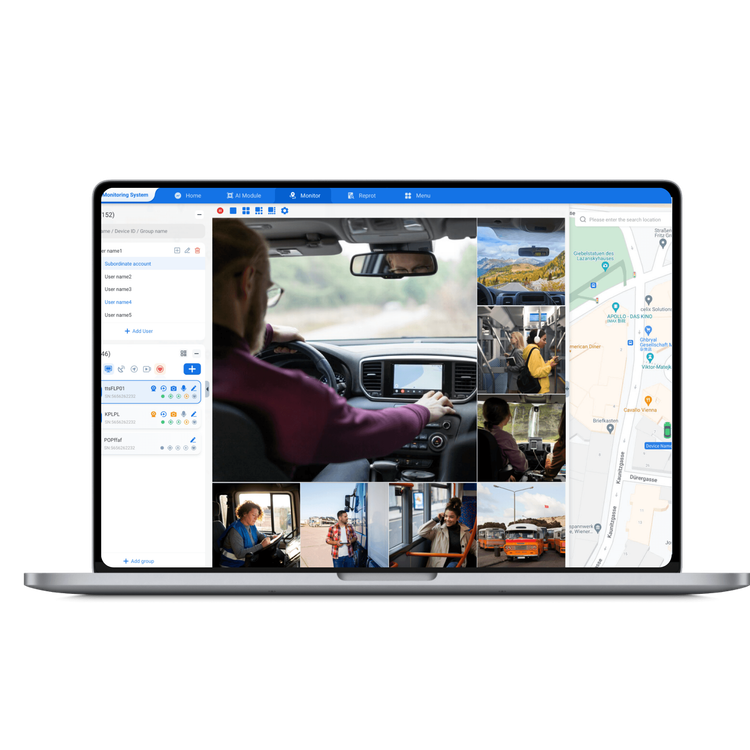
Selecting processing architecture resolves particular problems and creates new trade-offs. Edge-first designs reduce upstream bandwidth and preserve longer pre-event buffers at the device, but they concentrate detection logic on hardware that may drift without remote calibration. Cloud-centric designs centralize analytics and make multi-stream correlation simpler, yet they increase latency and require robust upload policies. Hybrid approaches perform initial detection at the edge and push high-confidence clips and synchronized metadata to central stores for forensic review. When integrating with broader operational data, choose architectures that make it straightforward to pair video timestamps with telematics records; many fleets realize this by combining camera-side processing with centralized fleet telematics solutions that normalize vehicle telemetry and provide consistent timestamping.
Operational best practices and common pitfalls
Practical controls reduce noise and improve admissibility. Implement these practices and avoid the listed pitfalls:- Calibrate clocks and camera alignment during installation and at scheduled intervals; neglect leads to ambiguous timelines. – Enforce mandatory metadata capture at source; absence of CAN or driver ID fields renders video less useful. – Limit reviewer workload by tuning detection thresholds and providing confidence bands rather than raw alerts. – Maintain cryptographic hashes and immutable logs to preserve chain-of-custody; failing to do so risks legal exclusion. – Test retention and retrieval workflows under load; many fleets discover missing footage only during litigation. Do not assume default device settings are sufficient. Regular audits and documented repair workflows are necessary to sustain evidence quality over time.
Validation protocol: how to prove your system works
A defensible reporting system requires objective validation. Adopt a three-tier protocol:1) Ground-truth trials: run controlled drives that simulate targeted incident classes and verify that each camera, sensor, and processing path generates expected metrics. 2) Periodic sampling: randomly select recorded incidents for manual reconstruction to measure precision and recall of automated detections. 3) External benchmarking: compare key indicators (time sync, GPS accuracy, detection precision) against independent references. Jurisdictions with heavy regulatory scrutiny, such as California, increasingly demand verifiable telematics and video records; use that expectation as a baseline when designing validation scopes.
Conclusion: prioritize measurables that resolve dispute and reduce review cost
The problem-driven task for fleet managers is clear: convert tri-channel footage into reproducible, auditable narratives by measuring and enforcing metadata integrity, synchronization, and correlation with vehicle telemetry. Prioritizing these measurable properties reduces reviewer time, strengthens evidentiary value, and aligns operational practice with legal and insurer expectations. Operational teams that adopt these measures alongside integrated fleet telematics capabilities will achieve consistent outcomes; those capabilities are evident in providers such as BSJ, which emphasize synchronized metadata, validated storage, and integrated telemetry rather than raw video alone.